



Since our Marketing Meets GenAI article was published in April 2026, the European Commission published (i) its final Code of Practice on the Transparency of AI-Generated Content on 10 June 2026 (“CoP”), and (ii) its final Guidelines on the implementation of the transparency obligations for certain AI systems under Article 50 of AI Act on 20 July 2026 (“Guidelines”). The CoP and the Guidelines are explicitly non-binding, but provides helpful insight into how the transparency obligations under the EU AI Act may be applied in practice. The rules discussed below have broad territorial application: they apply where content is “used in the EU”, which means when the deployer foresees use in the EU (e.g. by directing/authorising distribution there) or when content is made available “on the globally accessible internet”, according to the Guidelines.
When does content constitute a deep fake?
Article 50(4) EU AI Act requires that deep fake content be labelled as such. In relation to the definition of ‘deep fakes’ (Article 3(60)), the Guidelines provide for four cumulative criteria to capture content that has:
- Resemblance to:
- Existing:
- Persons, objects, places, entities or events:
- Falsely appears to a person to be authentic or truthful:
The resemblance has to be ‘appreciable’, i.e. a high level of similarity, looking at whether characteristic or distinctive features are represented by the deep fake. It is specified that the content does not need to be identical to the subject.
This refers to something that exists, can plausibly exist or could have plausibly existed in reality. By contrast, content items that “defy the laws of nature or physics or depict lifeforms that are not commonly accepted in biology (such as e.g. humans flying without mechanical aids, dragons, or elephants driving cars) are considered unrealistic and therefore fall outside the scope of the transparency obligation.”
‘Persons’ includes realistic human beings, including digital replicas of real persons, AI-generated human avatars, and personal characteristics or expressions (e.g. image, voice, behaviour, performances). ‘Objects’ includes a realistic, inanimate material items (e.g. buildings, artworks, machinery, consumer goods etc). ‘Places’ is to be understood as realistic locations. ‘Entities’ is to be understood as realistic, non-human but animate beings (e.g. animals or other biological lifeforms). ‘Events’ includes realistic scenes or situations, including the depiction of professional or consumer services.
This is a holistic assessment which at its core aims to prevent the possibility of deep fake content being potentially deceiving or misleading as to its authenticity or truthfulness.
This criterion can be fulfilled even if the deployer (user) does not intend to deceive or mislead. Factors that should be considered include the potential substantive message of the content, the intended and foreseeable deployment contexts, the environment in which the content is presented, and the intended and reasonably foreseeable audience composition and their expectations.
The emphasis on the reasonably foreseeable audience is key for marketing businesses, and the Guidelines emphasise due consideration of whether the deep fake content may, at some point, be perceived by children, the elderly, or others with lower digital and AI literacy or general knowledge levels, who may be more easily deceived or misled regarding the content’s authenticity or truthfulness. Where such vulnerable audiences form part of the reasonably foreseeable audience, it is sufficient that the content falsely appears authentic or truthful to that segment of the audience for it to qualify as a deep fake. That said, deployers are not required to account for further dissemination by third parties beyond the reasonably foreseeable audience, having regard to the intended distribution channels (e.g. content shown solely on a subscriber-only section of a website or in a corporate newsletter does not require the deployer to assume broad public accessibility). Conversely, if the audience would not expect the content to be authentic or truthful, the content will not satisfy the criterion of 'falsely’ appearing to be authentic or truthful, even where it is in fact non-authentic or untruthful.
For example, AI-supported manipulation of insignificant substantive or technical aspects of pre-existing content may have a minor impact on the audience’s perception of the contents’ authenticity or truthfulness. This can include editing backgrounds for clearly aesthetic purposes, lighting adjustments, colour correction, noise reduction. In an advertising context, the Guidelines give the example of compositions and arrangements of arrangements of existing products, or re-scaling of images applied in product advertisements or packaging. However, there can still be cases where substantive AI-powered editing of background details likely negatively affects the content’s authenticity and truthfulness, such as in relation to journalistic images. The distinction drawn by the Guidelines in relation to product imagery is of particular practical significance for marketing businesses.
The Guidelines then applies the above criteria to specific examples. In a marketing context:
| Deep fake | Not a deep fake |
|
|
Artistic, creative, satirical, fictional or analogous content
The Guidelines clarify that the AI Act foresees an attenuated transparency disclosure for deep fakes forming part of evidently artistic, creative, satirical, fictional or analogous works or programmes. The Guidelines specify that although the AI-origin of the content or its manipulation is still required to be disclosed, but this obligation is limited to the disclosure of the deepfake content in a manner that does not hamper the display or enjoyment of the work.
The Guidelines go on to provide examples of artistic, creative and fictional works:
- Artistic/fictional work: AI-generated special effects in movie scenes that constitute deep fakes such as simulations of actors, de-aging of existing actors, digital replicas of dead persons etc.
- Artistic/creative work: AI-generated music in any kind of genre resembling the style of existing artists.
- Satirical/fictional work: an AI-manipulated image of an existing politician placing him in a scene clearly meant to criticise certain policy decisions taken or supported by that person.
- Analogous creative/fictional work: AI-generated gaming imagery involving deep fake simulations of existing persons or locations.
Of particular relevance in a marketing context is the fact that if the nature of content is exclusively informative or commercial and is recognisable as such, it does not fall within the above categories and cannot benefit from the attenuated transparency regime. Advertisements may in certain, specific situations be regarded as evidently creative or fictional works, but this is assessed on a case-by-case basis and the categories are to be interpreted strictly. When the deep fake combines multiple characters (e.g. informative and creative), the informative character should always prevail and require compliance with the standard labelling requirements. The Guidelines explicitly state that the following examples do not constitute artistic, creative, satirical, fictional or analogous works (and so will not benefit from the attenuated transparency regime):
- AI-manipulated video in the style of a teleshopping channel involving deep fake simulation of humans advertising a product in an AI-generated scene depicting the functional use of the product by the simulated consumers with the aim of persuading viewers to buy the product.
- AI-generated imagery of celebrities implying their involvement in activities that never happened, lacking any fictional, satirical or analogous purpose.
- AI-manipulated video featuring a realistic synthetic influencer testing out a sponsored real product, focused solely on displaying the product functionalities.
AI-generated or manipulated text
Pursuant to Article 50(4), second subparagraph, of the AI Act, if an AI system is used to generate or manipulate text published with the purpose of informing the public on matters of public interest, labelling is required:
- Informing the public: the AI-generated or manipulated text must be intended to communicate knowledge, opinions or facts. This can often be satisfied by marketing campaigns referencing consumer survey data or other facts such as problem statement statistics or claims about the product itself.
- On matters of public interest: the Guidelines state that this covers matters relevant to society at large, such as politics, public services, law enforcement, protection of fundamental rights, public security, public health, environmental protection, consumer safety and any economic, financial, political scientific, or cultural development that may be relevant subject of public debate. It is possible that certain marketing campaigns will cover such issues, particularly those relating to public health, environmental protection and consumer safety.
The Guidelines gives the example of AI-manipulated parts of a lifestyle-website article comparing the effects of various diets on a particular disease in middle-aged women falling within Article 50(4), which would be relevant to comparative advertising approaches often used in marketing. On the other hand, the Guidelines set out that AI-manipulated text that is part of a company’s advertisement or product descriptions (not including any claims related to e.g. health, consumer safety or sustainability) would fall outside the scope of Article 50(4).
However, Article 50(4), second subparagraph, AI Act provides an exception to this labelling obligation where two cumulative conditions are met:
- the AI-generated or manipulated text has undergone human review or editorial control, which must include, at a least, fact-checking the accuracy of the content. Superficial or solely formal checks (e.g. spell-checking or grammatical correction) are not sufficient to meet this condition; and
- a natural or legal person must hold editorial responsibility for the publication, meaning that they bear ultimate legal responsibility for the published content, including the human review or editorial control process.
Labelling practicalities
If content does constitute a deep fake, the basic obligation for the deployer (user) of AI systems under Article 50(4) and (5) AI Act is to:
- disclose that the content has been artificially generated or manipulated
- in a clear and distinguishable manner
- at the latest at the time of the first interaction or exposure.
Our previous article references the Second Draft CoP on Transparency of AI-Generated Content, which dealt with how labelling should be applied to deep fake content. The final version of this CoP has since been published (on 10 June 2026).
The signature of the CoP remains voluntary, although in practice the transparency obligations under Article 50(4) AI Act are likely to be interpreted through the lens of the CoP. Non-signatories are expected to demonstrate compliance through other adequate means. A pragmatic approach for non-signatories is therefore to use the CoP as a baseline and work through its requirements systematically, identifying where full compliance is achievable and, where it is not, documenting the reasons why not and whether any alternative measures were put into place.
For visual content, the CoP requires the label to include the acronym "AI" and signatories are only encouraged to supplement the acronym with information to indicate whether the content has been "modified" or "generated" by AI. The label must be clear, accessible, and distinguishable – i.e. immediately recognisable to natural persons. It should be directly embedded into the content where practicable, remain visible for a sufficient duration to be noticed, maintain sufficient spacing from other overlay elements, and remain visible against any background.
- For video content specifically, the label should be displayed at the beginning of the video and, where possible, at regular intervals throughout – and at a minimum after any interruptions (e.g. advertising breaks) – to account for situations where different persons may be exposed to the content at different moments.
- For published text, the label should appear above or at the top of the content, or near the headline.
For audio-only content (or other content where visual disclosure is not possible), the CoP requires a short audible disclaimer in plain and simple language (either in the same language than the content or in English) at the beginning of the deep fake. Again, it should ideally indicate whether the content was AI-generated or AI-manipulated. This disclaimer may take the form of a spoken statement, such as a tone, or an ‘earcon’. The CoP also requires that other accessible forms of disclosure be considered, such as tactile and haptic cues or high-contrast icons, to ensure inclusivity.
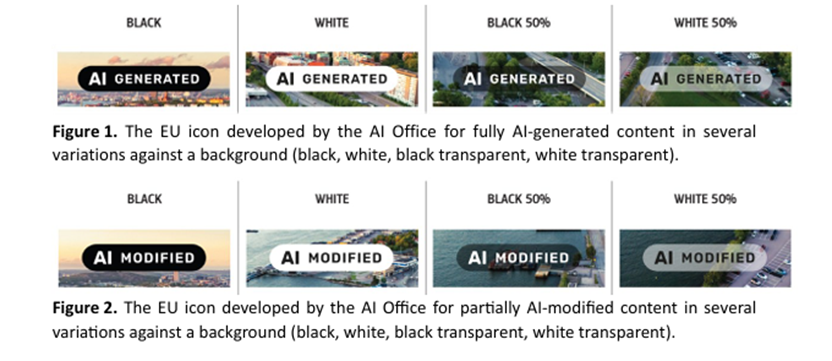
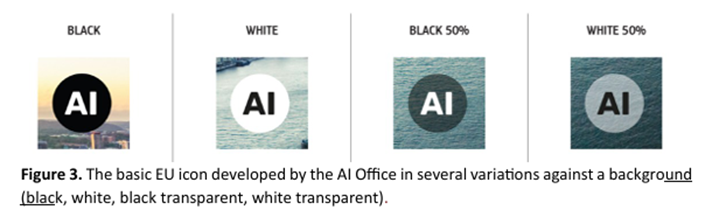
The CoP offers a suite of optional icons that deployers may choose to adopt. These include a dedicated icon for fully AI-generated content, a separate icon for AI-modified content, and a basic "AI" icon designed to be supplemented with an interactive layer providing additional information. An audio-only EU icon is also to be developed.
Practical Takeaways
Whilst the publication of both the final Guidelines and the final CoP provide welcome clarity to marketing businesses navigating AI-generated or modified content, both documents emphasise on numerous occasions that the application of the transparency obligations is dependent on a case-by-case assessment. In particular, whether disclosure is required is not always clear-cut, particularly where content combines AI-generated and authentic elements, or where the substantive message of the content and the reasonably foreseeable audience composition are open to interpretation. Marketing businesses should therefore be reviewing their use of AI-generated and AI-manipulated content in light of these developments and taking steps to implement compliant disclosure practices.
As always, where you are unsure, are designing guidelines, or require peace of mind on a major campaign, just reach out to us with your questions.
/Passle/64ef1c9c95186b4923406017/MediaLibrary/Images/2026-09-10-11-44-42-935-6aa2982a842cad5c5a74c193.png)
/Passle/64ef1c9c95186b4923406017/MediaLibrary/Images/2026-07-21-10-31-24-032-6a5f4a7c1b7078c1ea9a85a1.jpg)
/Passle/64ef1c9c95186b4923406017/MediaLibrary/Images/2026-08-19-14-13-52-053-6a85ba20d8729b0fe9ed3cb1.jpg)
/Passle/64ef1c9c95186b4923406017/MediaLibrary/Images/2026-07-27-08-27-54-478-6a67168aa3513a74a4f36a89.jpg)