
Damages inquiries for trade mark infringement used to be relatively rare in the UK and the principles for quantifying damages for intellectual property (IP) infringements were well-established. However, the number of inquiries going all the way to a trial and judgment seems to be on the increase, and the courts are having to determine cases where the established principles do not easily apply. The High Court’s recent judgment on the damages inquiry in Montres Breguet S.A. & Ors v Samsung Electronics Co Ltd & Anor [2026] EWHC 2228 (Ch) is one such example.
Characterised by the claimants as the “largest-ever” and by the defendants as “one of the smallest and most-trivial” trade mark damages inquiries before the UK courts, Marcus Smith J rejected both the comparables and economic benefits approaches as unreliable in this unusual set of circumstances. Instead a new ‘third way’ was formulated that neither valuation expert had considered – an “insurance against infringement” approach, under which the licence Samsung needed was a form of contingent protection against a known and foreseeable risk of infringement materialising, despite its efforts to prevent it.
Although the concept was not well received by either party, it did avoid the extreme outcomes put forward by the parties – the Swatch group’s expert quantified damages at an eye watering US$170 million, whereas Samsung’s expert quantified those same infringements at just US$301. Whether the assessment stands remains to be seen – Samsung has been granted permission to appeal by the High Court.
Background
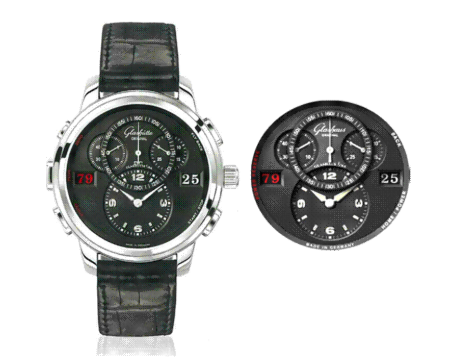
Various members of the Swatch group of watch makers operating brands such as Swatch, Tissot, Omega, Longines, Breguet, Blancpain, Glashütte Original and Jaquet Droz brought a trade mark infringement claim against Samsung. The Swatch group alleged that Samsung was infringing a number of its trade marks by making available watch face apps on the Samsung Galaxy App store (“SGA Store”) from October 2015 to February 2019. The apps displayed watch faces featuring dial branding with a name or sign either similar or identical to Swatch trade marks in the centre of the watch face (see the example reproduced from the Court of Appeal’s judgment below).
The Swatch group was successful in establishing trade mark infringement in the first instance decision and this was confirmed by the Court of Appeal. In summary, in the liability judgment Falk J had identified three overall groups of infringements by Samsung:
- Dial Branding Infringements – those infringements appearing on the watch face itself;
- Store Display Infringements – uses on the SGA Store to market and promote the watch face apps; and
- Double-Barrelled Infringements – a combination of both Dial Branding Infringements and Store Display Infringements.
At the damages inquiry, Smith J therefore had to determine the appropriate damages to be paid by Samsung to Swatch for those infringements.
Damages assessments in the UK
There is a well-established set of principles to quantify damages for IP infringements in the UK which stems from the landmark House of Lords decision in General Tire and Rubber Company v Firestone Tyre and Rubber Company [1975] 1 WLR 819. The object of the exercise is to compensate the IP owner so that they are in the same position had the infringement not occurred. In quantifying damages, there are broadly three different types of cases:
- Established Rate of Profit – Measuring the profit that has diverted from the IP owner to the infringing party if the IP owner has lost sales.
- Established Royalty Rate – Calculating an appropriate royalty payment for use of the IP where the IP owner in fact licenses the infringed IP – this is where comparable licences become relevant. Courts will take into account evidence of a standard royalty rate charged by the IP owner in the same market between other parties in the same commercial context in determining the damages. However, as Marcus Smith J noted in his judgment those comparables “have to be genuinely comparable, otherwise the outcome is simply arbitrary”.
- No Established Rates – If there are no lost profits or established licence royalty rates, the judge must still assess damages using the best available evidence of market practice, profitability and any factor which can help to decide the measure of loss to the IP owner. The court will conduct a ‘negotiating damages’ assessment – this relies on the user principle (i.e., in a hypothetical negotiation between a willing licensor and licensee, what notional licence fee would be agreed for the infringing use of those rights).
The Swatch group does not license its marks to third parties at all, nor did Samsung produce rival products to divert sales away from the Swatch group. Therefore this case fell squarely within that third category. The challenge for the judge was to find a “rationally and not arbitrarily calculated” damages figure.
An unusual set of circumstances
The difficulty for “third category” trade mark infringement cases is the potential lack of any objective starting point for the assessment given that many brands do not license their trade marks to third parties in comparable ways to the use found to have infringed. As a result, the parties, their experts and the judge faced a difficult exercise of determining a fair and objective basis to compensate the brand owner for the use of the trade marks.
With no objective comparables in this case, the parties’ experts presented the ‘economic benefits’ approach as the alternative valuation method. This approach seeks first to estimate the incremental economic benefits expected to be obtained by the licensee through use of the IP and those expected to be foregone by the licensor, and then to consider how the net benefit should be shared between the parties. Whilst Smith J recognised it could be helpful in some cases (such as the damages inquiry in Merck KGaA v Merck Sharp & Dohme LLC & Ors [2025] EWHC 2376 (Ch)), he considered that this “third category” would rarely be resolved on that basis and cautioned that care should be taken when using this expected benefits approach to avoid “becoming the equivalent of an account of profits”.
The basis for the parties’ valuations
The judge rejected the approaches of both parties’ experts. Each expert proceeded to simulate the hypothetical negotiation on very different bases (which ultimately led to the extremely different quantum assessments). His criticisms included:
- Swatch’s expert: Assumed a full co-branding exercise which Samsung had never intended or contemplated and went far beyond the scope of licence needed in this case. For example, there was no physical branding or hardware modifications that would have infringed any of the Swatch group’s brands. However, Smith J did accept the significant evidence on the value of brands generally. In particular, for watches, brands are extremely valuable to the Swatch group and not a form of property that they were prepared to license to third parties (which should be factored into the negotiation).
- Samsung’s expert: Put forward a very limited exercise which looked at quantifiable economic benefits only, excluding the inherent value which attaches to the trade marks and understating the value of the ecosystem of apps available on the SGA Store. The approach ignored the fact that Samsung designed the ecosystem to rely heavily on populating the SGA Store with a vast range of apps (many of which are free) to appeal to smartwatch users. Further, although Samsung itself did not value the use of the Swatch group trade marks, it did value running a lawful, compliant business and therefore the cost of such a licence would be unavoidable due to the business model which it had adopted.
Smith J therefore concluded that the scope of what Samsung needed represented a limited “insurance against infringement”. This would result in the validation of any Dial Branding Infringements and/or Store Display Infringements pending removal by Samsung following identification of those infringements. Consequently, Samsung would only need to pay damages for that period of infringement pending removal.
The judge’s assessment
So, how did the judge arrive at US$11.6 million as the negotiating damages in this case? Smith J acknowledged that there was a “broadbrush element” to the assessment, however there was sufficient evidence before him to justify the figure:
- For the Store Display Infringements, the Judge concluded that there should be a separate flat fee of US$10 million, using indicative evidence of the full co-branding exercise.
- For Dial Branding Infringements, the royalty calculation was based on actual sales by Samsung at the actual rates sold – a rate of 20% (proposed by Swatch’s expert) was applied to the cost of each actual watch sold ($220). This was then multiplied by the number of downloads of infringing watch face apps (160,000). However, the 20% rate was then reduced on the basis that it was “obviously too high” when factoring in it was not a full co-branding exercise covering hardware and software cost of a Samsung smartwatch. The judge therefore concluded a flat fee of US$10 per download (i.e., a total of $1.6 million) for the Dial Branding Infringements was appropriate in respect of software only.
Conclusion
The judgment adds to the increasing body of case law on the assessment of ‘third category’ trade mark damages inquiries where no relevant market comparables or established licence royalty rates exist. The High Court awarded negotiating damages of $11.6 million in this case. Following a consequentials hearing, Samsung has been granted permission to appeal. It therefore remains to be seen whether this valuation concept and the resulting damages calculation will be upheld or overturned on appeal.