


This article explores the registrability requirements and considerations for obtaining valid shape marks in Italy and other countries within the European Union.
1. The Evolution of Trademark Protection
In a fast-paced world, the protection of IP rights is in constant evolution.
With specific regard to the European Union, and in particular to the world of distinctive signs, there has been a significant shift over recent years. Trademarks were once conceived by companies as merely a word or logo. Today, the concept of a "trademark" encompasses far more than these traditional forms.
2. The Rise of Shape Marks in Brand Strategy
In this context, numerous brands across diverse sectors are now attempting to register and/or enforce the shape of their product packaging, and even the shape of the products themselves, as trademarks (both registered and unregistered). The clear intention is to combat the lookalike phenomenon or, to use a term that has become increasingly popular in recent times, "dupes".
In other words, brands seek to oppose the production, marketing, and promotion of articles that reproduce, in an identical or similar manner, the aesthetic and shape characteristics of their original products.
3. Key Questions: Registrability, Enforcement, and Scope of Protection
But is it straightforward today to obtain registration of, and/or enforce, a shape mark for a particular product? And once a trade mark registration is obtained for a shape mark, what is its scope of protection? In other words, how different must the shape adopted by a competitor be to exclude infringement?
The most honest answer is: it depends. But on what?
Mainly on the characteristics of the product at the time of its creation, but also during its lifecycle.
4. Absolute Grounds: What Cannot be Registered or Enforced
Regarding the characteristics of the product present at the time of creation, shapes consisting exclusively of the following cannot constitute the subject matter of a valid shape mark:
- the shape, or other characteristic, imposed by the very nature of the product;
- the shape, or other characteristic, of the product necessary to obtain a technical result;
- the shape, or other characteristic, which gives substantial value to the product.
One might assume that a shape without any of these characteristics is automatically registrable and/or enforceable as a trademark.
Unfortunately, the answer is no.
The Critical Role of Distinctive Character
It is also necessary to consider what happens to the shape during its lifecycle.
A shape mark remains, after all, a trademark which, to be valid, must satisfy its primary function: indicating the origin of a particular product from a particular undertaking. This is known as "distinctive character".
Therefore, shapes that lack distinctive character cannot constitute the subject matter of a valid trademark.
5. Building Distinctiveness: From Weak to Strong Marks
The good news, however, is that this requirement is mutable over time, thanks to the entrepreneurial efforts of individual companies.
On a scale from 0 to 100, where 0 corresponds to a trademark devoid of distinctive character and 100 to a highly distinctive trademark (a so-called "strong" mark), the distinctiveness of a mark can move across the entire scale:
- from 0 to 100 – this phenomenon is known as "secondary meaning" or "acquired distinctiveness"; and
- from 100 to 0 – this phenomenon is known as "genericisation".
6. Proving Acquired Distinctiveness: The Evidence That Matters
But what data is considered most effective by both Italian courts and European trademark offices to demonstrate that a shape mark originally endowed with limited distinctive character has subsequently become a "strong" shape mark?
The list could be very long, but key examples include:
- the number of sales;
- promotional investments made online and offline;
- awards and recognition received from the market, for example in the press;
- but, probably above all else, the results of market surveys.
Market surveys—when supported by appropriate documentation—are extremely effective in demonstrating the necessary distinctive character of a particular shape, or more generally of any sign, in the eyes of consumers.
The results of such surveys show with immediate evidence the percentages of users who, when presented with a particular sign, recognise it as a trademark rather than as a generic product.
7. Success Stories: Validly Registered or Enforced Shape Marks
Since images often speak louder than words, below is an image of a shoe shape for which Bird & Bird's Italian team (Massimiliano Mostardini, Paola Ruggiero, and Francesca Rombolà) successfully obtained trademark registration in Italy, thanks to efforts in gathering evidence to support its enhanced distinctive character:
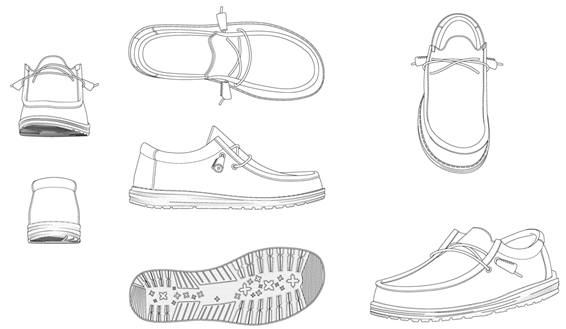
HEYDUDE WALLY by Crocs
8. Conclusions: A Strategic Approach to Shape Mark Protection
The registration and enforcement of a shape mark is a complex activity that requires close collaboration between client and lawyer, with numerous factors coming into play.
It is therefore critical to create a synergistic and strategic connection whenever there is a business interest in attempting to obtain exclusivity over the shape of a new product. This enables the implementation of the right protection strategies from the outset.
For any information or advice, please contact your usual contact at Bird & Bird to discuss.
/Passle/64ef1c9c95186b4923406017/MediaLibrary/Images/2026-09-10-11-44-42-935-6aa2982a842cad5c5a74c193.png)
/Passle/64ef1c9c95186b4923406017/MediaLibrary/Images/2026-07-21-10-31-24-032-6a5f4a7c1b7078c1ea9a85a1.jpg)
/Passle/64ef1c9c95186b4923406017/MediaLibrary/Images/2026-08-19-14-13-52-053-6a85ba20d8729b0fe9ed3cb1.jpg)
/Passle/64ef1c9c95186b4923406017/MediaLibrary/Images/2026-08-04-15-18-04-393-6a7202ac1468addd2c3b6d62.jpg)